

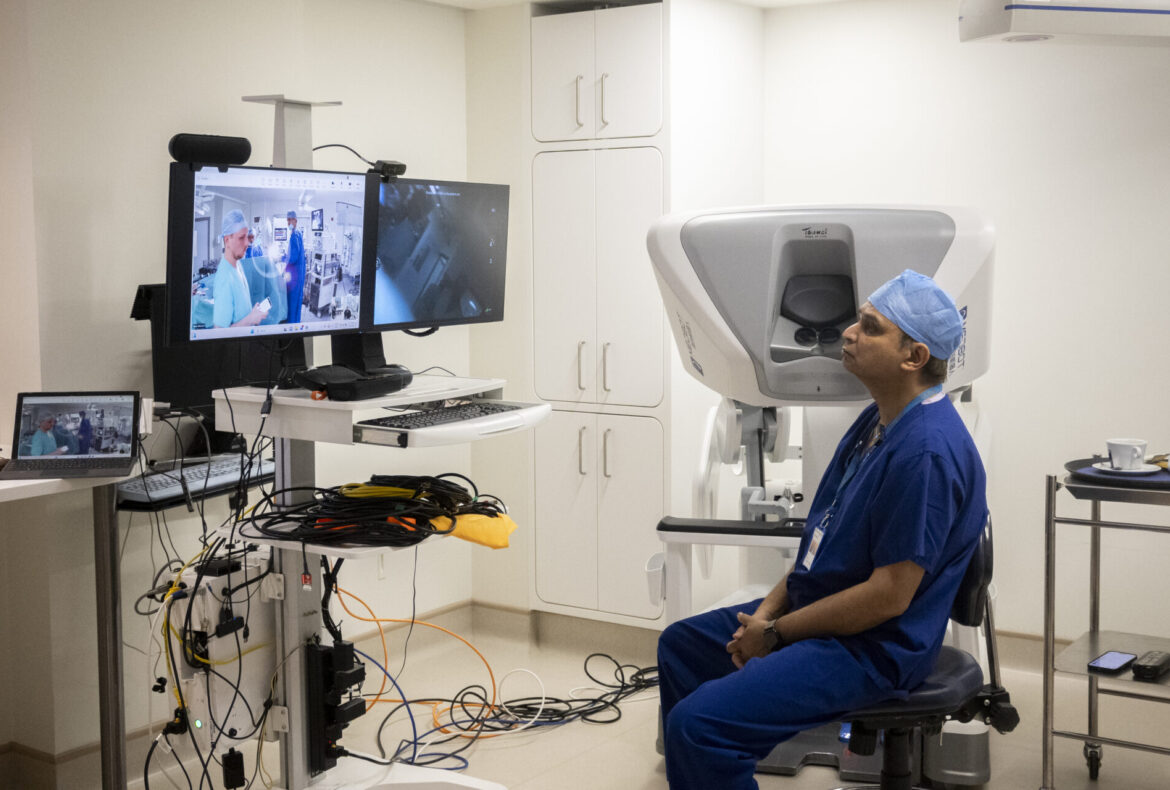
In a landmark moment for global healthcare, Prokar Dasgupta, a London-based surgeon and pioneer in robotic urology, has successfully performed the United Kingdom’s first long-distance robotic prostatectomy—marking a major step forward in how surgical care can be delivered across borders.
Breaking barriers in patient access
The patient, 62-year-old Paul Buxton, was based in Gibraltar, over 1,500 miles away from London. Having relocated there from England four decades ago, Buxton was diagnosed with prostate cancer shortly after Christmas. Faced with the prospect of travelling back to the UK and navigating potential delays within the National Health Service, he chose instead to take part in a groundbreaking clinical trial.
For Buxton, the decision was clear—he “jumped at the chance” to receive advanced care without the need for travel or long waiting times.
Surgery without borders
On February 11, 2026, Professor Dasgupta performed the prostate removal procedure remotely from London, using the innovative Toumai Robotic System. The system, developed through a collaboration between The London Clinic and the Gibraltar Health Authority, features a four-armed robotic unit equipped with a high-definition camera.
The setup was supported by a high-speed fibre-optic connection, with 5G backup, resulting in an almost imperceptible delay of just 0.06 seconds between the surgeon’s movements and the robot’s response. A full surgical team remained on standby in Gibraltar to ensure patient safety throughout the procedure.
A glimpse into the future of surgery
“This gives us the opportunity to treat patients in remote areas and smaller communities by literally being able to take the best surgeon anywhere,” said Professor Dasgupta. “It is very, very exciting.”
And this is just the beginning. Following the success of the first operation, Professor Dasgupta completed a second remote procedure on March 4 for a 52-year-old patient, with further surgeries already scheduled—signalling the rapid progression of this technology from trial to potential mainstream adoption.
Redefining global healthcare delivery
This breakthrough has far-reaching implications. Remote robotic surgery could:
- Reduce waiting times for critical procedures
- Eliminate the need for long-distance patient travel
- Improve access to specialist expertise in underserved or remote regions
- Enhance collaboration between international medical teams
In an increasingly connected world, the ability to deliver high-quality surgical care across continents could transform healthcare systems as we know them.
A pioneer behind the innovation
Professor Dasgupta, a British Bengali surgeon, brings a wealth of academic and clinical excellence to this achievement. Educated at St. Xavier’s College in Kolkata and St. Paul’s School in Rourkela, he now serves as Professor of Robotic Surgery and Urological Innovation at King's College London.
Patient outcome: A success story
As for Paul Buxton, the results speak volumes. “I feel fantastic,” he shared following the surgery—a powerful testament to both the success of the procedure and the life-changing potential of this innovation.
This historic procedure is more than a technological milestone—it represents a shift in how we think about access, equity, and excellence in healthcare. With leaders like Professor Dasgupta at the forefront, the future of surgery is no longer bound by geography.